By Angelica Sciumbata
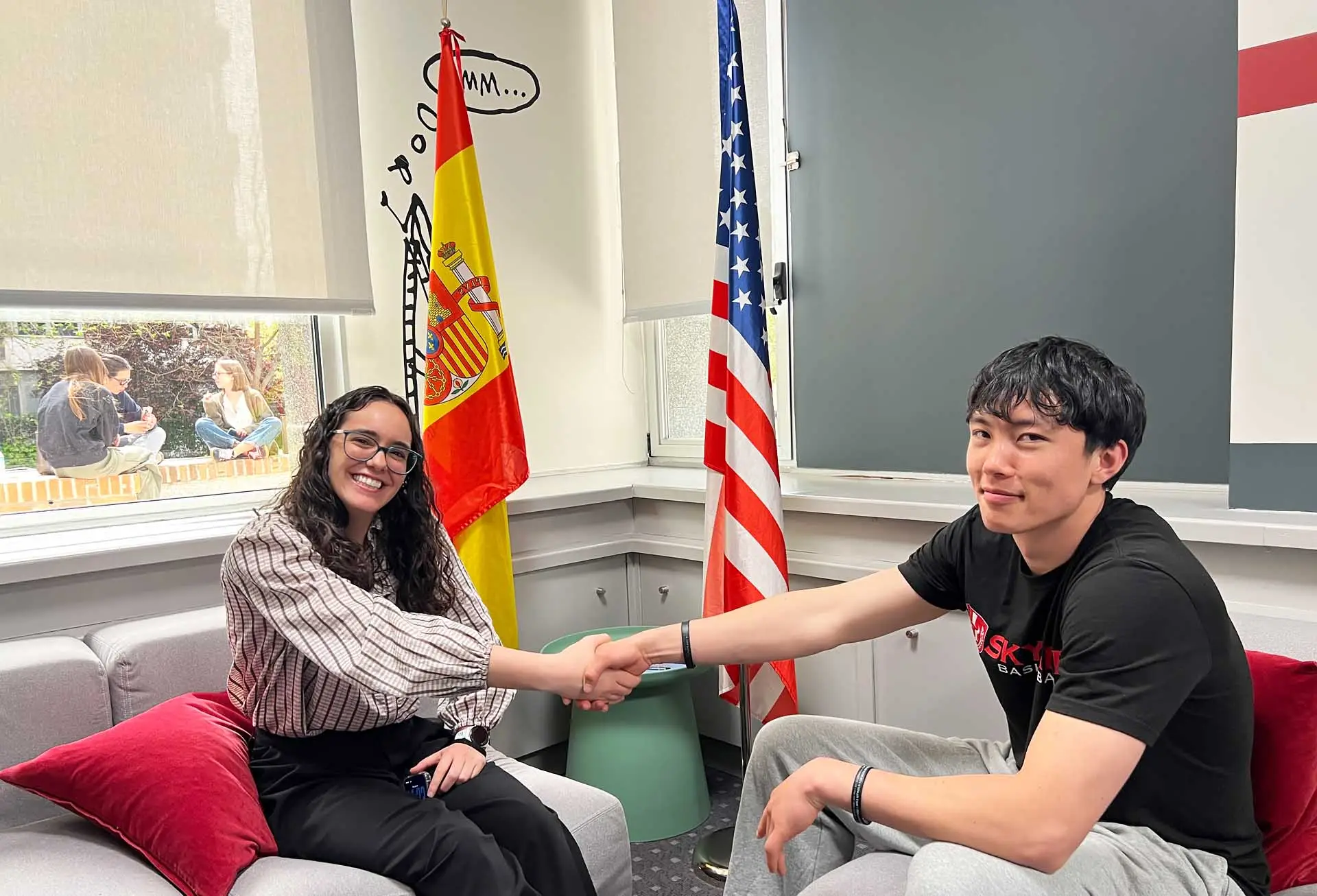
At the CIS University campus, language learning goes beyond school hours. The Language Exchange Program (LXP), led by Professor Tracy Wood, brings together around 100 students from all over the world to practice languages, share cultures, and make friendships with the goal of creating cohesion in the campus community.
The program began as a way to pair Spanish speakers with the Endicott students who were coming to CIS for one or two semesters. Since then, it has evolved into something much broader. Each semester, more and more students have enrolled in the program, making it increasingly diverse and structured.
“If language is the primary goal of the language exchange program, then culture and friendship are secondary goals. So it’s not simply about language,” said Dr. Tracy Wood, who is the Language Exchange Program coordinator. Today, the initiative includes 11 languages: English, Spanish, French, Italian, Dutch, Swedish, Russian, Arabic, Portuguese, Chinese, and American Sign Language (ASL).
Students sign up through a form listing the languages they speak and want to learn. Wood then carefully matches partners, aiming to pair students with complementary goals. Once matched, participants start meeting regularly on campus, alternating between the two languages. Finally, if the program rules are respected, students can earn up to 5% extra credit in communication or language courses. Yet, despite the extra credit being the main motivation for many, students reported deeper benefits: they gained new friends, developed new perspectives, and felt more comfortable in the campus community.
Students Paula Ruiz and Damascus Shields, one of the exchange pairs, are practicing Spanish and ASL this semester. For them, the exchange became a space for mutual learning and discovery. Paula joined to explore ASL and, at the same time, get extra credit, while Damascus wanted both help in Spanish and “to be able to teach a language that isn’t commonly taught”.
“We mainly learned things that we were interested in. I wanted to learn basic signs, so in the future I could communicate with someone who uses ASL,” said Paula. “When we worked on Spanish, we would just go over things I didn’t understand in my Spanish class,” added Damascus. Both really enjoyed the program and found it useful. “It actually really helped me,” he said. “I wished we had more time because I would have loved to learn more,” Paula concluded.
Another pair, Caesar Randquist and Daniela Rubio, worked on Spanish and Swedish. Caesar applied to improve his Spanish to communicate better in everyday life; meanwhile, Daniela wanted to learn a completely new language and meet new people. “I would recommend it for mainly two reasons: you can learn a new language and make new friends,” said Caesar. “Before participating in the language exchange, we didn’t know each other, so getting to know him was an extra positive part of the experience,” added Daniela.
While extra credit may attract many to the program, what keeps students engaged goes far beyond grades. Through conversations, laughter, and curiosity, they are not only improving their language skills but also building bridges across cultures. The Language Exchange Program unites students from different countries. Its real success lies in how it creates cohesion and learning in the campus community.